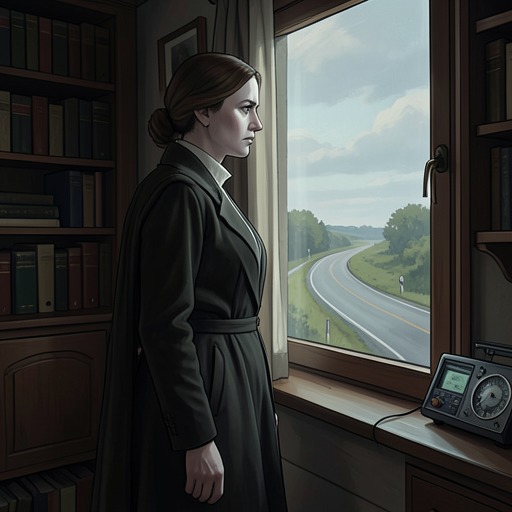
Raymond
Bonjour tristesseRaymond is Cécile’s father, confidant, and closest companion, a man whose warmth is genuine but whose appetite for novelty makes lasting commitments difficult. In Cécile’s retrospective account, he is neither loveless nor simply selfish: he loves his daughter deeply and can admire Anne Larsen, yet he treats desire as something to satisfy and complications as something to get past. That combination gives his charm its ease and his choices their cost.
Identity and Background
At forty, Raymond has been widowed for fifteen years. Cécile describes him as young in spirit, vital, full of possibilities, skilled in business, curious, and quick to tire. He attracts women and has changed partners roughly every six months. When Cécile leaves boarding school, she understands that he lives with women before she readily accepts how often one woman gives way to another. She comes to accommodate the pattern, partly because his new, easygoing life appeals to her and partly because she knows how much he wants female companionship.
His lightness does not cancel his tenderness toward Cécile. He is kind, generous, cheerful, and openly affectionate; she regards him as an ideal friend as well as a father, and says she has never loved anyone as she loves him. He makes her an accomplice in his complications, and their shared laughter can make that alliance feel like a private game. But her later account insists that his love for her is not casual: he can suffer intensely on her behalf, and has sometimes given up other opportunities to accompany her home.
A Philosophy of Love
Raymond rejects fidelity, solemnity, and commitment as arbitrary and sterile ideas. In his view, love can be brief and intense without being false: because he expects his tenderness and devotion to be temporary, their impermanence does not prevent them from being real. Cécile finds this model attractive while she is young and inexperienced, acquainted with love chiefly through meetings, kisses, and the weariness that follows. His outlook helps establish a household in which pleasure and affection are readily available, but permanence carries little authority.
The difference between his principle and its consequences becomes sharper when Anne arrives. Raymond has asked Cécile whether Elsa Mackenbourg’s company will bother her during the holiday, showing his usual consideration for his daughter even as he keeps a mistress. When Anne is due at the station, he and Elsa go to meet her; Cécile refuses to join them, and Raymond gathers the garden’s gladioli to present to Anne. The gesture is affectionate, but the situation also exposes the strain between his casual domestic arrangements and Anne’s more exacting sense of propriety.
Anne and the Prospect of Marriage
Raymond’s relationship with Anne develops beyond the loose pattern of affairs he has defended. When Anne tells Cécile that she and Raymond would like to marry, he looks down at his hands rather than offering his daughter the playful signal she hopes might make the announcement a joke. Cécile recognizes that the proposal is serious. For her, the news threatens the easy life she shares with her father; she begins to imagine the marriage as an intrusion into their established closeness.
Cécile later describes Anne as a woman Raymond loves and admires. Anne offers intelligence and experience that he can meet with his own, and satisfies his vanity, sensuality, and sensitivity. Yet Cécile doubts that he fully grasps the gravity of Anne’s feelings or thinks through what being a husband entails. In her estimate, he can imagine Anne as the ideal mistress and mother to Cécile more readily than as an ideal wife bound to him by obligations. The distinction reveals a gap between his capacity for feeling and his willingness to imagine the structure that feeling might demand.
Cécile’s Scheme and Raymond’s Desire
When Elsa returns and asks whether Raymond is happy, Cécile recognizes an opening. She tells Elsa that Anne is skillful and constraining, then presents the proposed marriage as a threat to all three of them and Raymond as a great child who needs defending. Cécile’s plea draws on Elsa’s continuing attachment to Raymond, but it also disguises her own opposition to Anne’s place in the family. Raymond is not the architect of this appeal; he becomes its target, as Cécile and Elsa create the appearance that Elsa and Cyril are together.
Cécile later explains that Raymond treats his renewed desire for Elsa not as evidence that he loves Anne less, but as an inconvenient appetite that should be acted on quickly before it creates trouble. He admires Anne, but his habitual response to desire is practical and immediate rather than reflective. Cécile’s staged scenes exploit that weakness: when he sees Elsa and Cyril apparently happy together in the pine wood, he stands pale and fixed, then turns away and strides off. Cécile has helped direct his thoughts so effectively that she is frightened by how well she knows him. His distress is real, but the scene is also part of a manipulation whose emotional effects she does not fully control.
Exposure and Narrative Significance
Cécile’s retrospective portrait refuses to reduce Raymond to a villain. She calls him irretrievably light, and describes his tendency to explain emotional discomfort in physiological terms: if she feels wretched, he advises more sleep and less drink. He is materialistic in this sense, but she also remembers him as delicate, understanding, and very good. His affection and his irresponsibility coexist; neither simply explains away the other.
After Anne leaves, Raymond takes time to wipe Elsa’s lipstick from his face and brush pine needles from his suit before going to Cécile. Cécile turns against him in grief and calls him a scoundrel, while he anxiously asks what has happened and whether Anne is involved. At dinner, both father and daughter are distressed and want Anne to return. The plans Cécile had patiently assembled no longer feel like clever play, and Raymond’s familiar freedom from settled expectations has become a source of shared disorientation. Through him, the novel links pleasure to genuine tenderness while showing how a life organized around passing desire can leave its closest relationships vulnerable to the very instability he once treated as harmless.